This research aims to discover the meaning of the silence between Me and Mazu, the Chinese sea goddess, through Luce Irigaray’s words about feminine genealogy. My inspiration for this research arose from the documentary film, The Last Breath of Sam Yan, which was produced by a group of students who protested against the removal of the Mazu Shrine, the last building standing within a construction site in the heart of an old Thai-Chinese community. The film compares Mazu with the last breath of the Sam Yan district. As for me, Mazu is the new breath of my 38 years as a Thai-Chinese woman. In my presentation, I related Mazu’s stories to my experiences in making handmade books called “zines,” independent publications that some feminists use for recovering and sharing our lostfeminine stories.
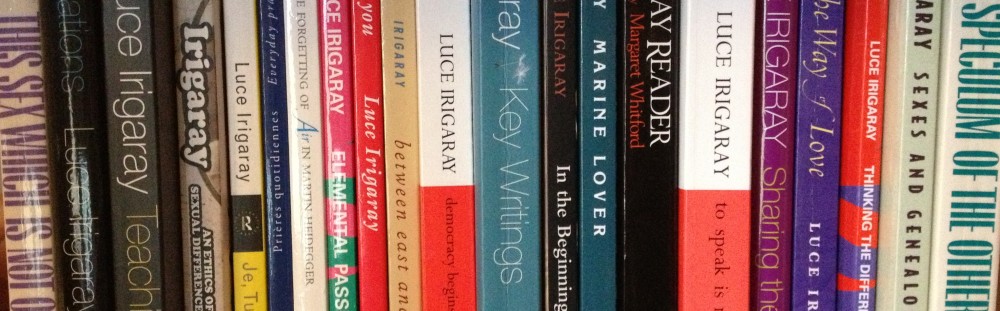
Before watching the documentary, I had just read about female genealogy in Je Tu Nous, a book by the French philosopher Luce Irigaray. According to Irigaray, we have forgotten something of our souls and that amounts to a disgrace. She also mentions that she is doing research on feminine figures of Greek and Roman mythologies like the goddess Hestia and Antigone. If I hadn’t read her book, I wouldn’t have reacted as much strongly as I did when I watched the documentary. I went home and looked up everything I could find about Mazu. My anger towards the university that wants to remove the Mazu shrine turned into an anger towards myself. Among the Chinese, Mazu is the anchor of hope for surviving the arduous journey undertaken to seek out a new life in a new land. My grandparents immigrated from China to Thailand. But why have I only learned about Mazu now?
Mazu was a young woman named Lin Mo. “Mo” was her first name and means “silence”, her name because she never cried when she was a baby. The word “silence” struck me. That it is something to which Irigaray often alludes. Another keyword of Irigaray’s work is “breath.” According to her, breathing is the first thing that we experience. It is something that our mother shared with us long before we could eat. But we often forget its importance. (« Avant de donner à manger, de se donner à manger, la femme donne ou, plus exactement, partage son souffle, sa vie : naturelle et spirituelle. Ce mystère, nous ne l’avons pas compris. Nous avons oublié, au niveau de l’existence et de l’être, l’importance du souffle dans la vie, humaine et divine », in Entre Orient et Occident, p. 107). My thoughts flashed back to the Mazu shrine. It is in the process of being torn down, replaced by another tall building complete with residential units and restaurants. Yet we forget the breath which is at the root of our culture. We can’t hold ownership over a piece of land forever. Moving or tearing down the shrine may, in the end, not matter most. But the disaster lies in our forgetting the soul that once dwelled on this land.
Irigaray says that we cannot lay claim on the air we breathe, but we can cultivate it – for ourselves, and for others (« Il est impossible de s’approprier le souffle, l’air. Mais on peut le cultiver, pour soi et pour les autres », in Entre Orient et Occident, p. 106). So what I can do is using my breath to extend Mazu’s breath through physical manifestation. As for me, I can’t live without books – reading, drawing, and writing books corresponds to my breath.
When Irigaray wrote about Hestia, the Goddess of the Hearth. I drew a picture of Hestia on a piece of paper. The color of the fire was evoked by folding joss paper, which, when it burns, is believed to bring wealth to ancestors in another realm. I viewed folding joss paper as a crafting project that could be done in silence. For my mother, this was a matter of following traditions. Personally, I loved holding paper – it was a small happy moment that I got to share with my mother and later developed into my D.I.Y. work. Today, I hold workshops to create “zines” (from the word “magazines”). Making zines is popular among feminist circles; it is a simple expression of the heart. Writing zines may be felt as being without direction and purpose, but in the end, a certain allure and knowledge is gained.
I invited a masculine friend to visit the Mazu Shrine and, then, we made zines and share our stories. I drew the decor inside the shrine. The statues of Mazu and the other gods have their own red curtains. I wrote down the French words “théâtre” and “marionnette,” which mean “theater” and “puppet,” respectively. It was a casual exploration of similarities between the Mazu Shrine and the theater. But, at the end, I was wondering why in this zine all the words that came to my mind started with the letter “M” – Mazu, Mo, marionnette and, then, a random word popped up in my mind: “Mary”, the mother of Jesus. Afterward, I did some research and found that the word “marionnette” does have connections with Mary. The theater has roots in religious beliefs.
Creating the zine made me realize that Mazu has brought me back to the memories of Mary when I was a weak and quiet girl. In the 1990s, my mother sent me to a Catholic school hoping that I would receive a western education. At school, I read books, I had secretive conversations with Mother Mary, I studied French and I grew up as a Buddhist woman who believes in Mary and read French philosophy. The entire time while writing this text, I have been thinking of Irigaray’s book Between East and West. The sadness that I felt because I did not remember Mazu earlier ceased – in fact, Mary was Mazu in another guise.
 Working with Luce Irigaray